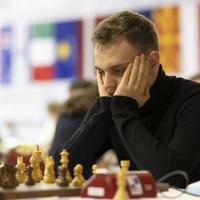
Emil Risteski
Emil Risteski, known online as EmilRisteski, is a FIDE International Master whose chess résumé has the feel of a player who arrived with a serious title and then made the internet do the proving. His story is not about one polished opening line or one famous win. It is about volume, variety, and a comfortable relationship with the kind of fast, messy, practical chess that either teaches you discipline or teaches you to regret the extra two seconds on the clock.
His preferred stage is blitz. That is where the profile feels most alive: enough time to understand the position, not so much time that every small weakness can be polished into a perfect counterattack. Emil plays like a player who is happy to let the position breathe, wait for the opponent to reach for a clean move, and then answer with something a little more troublesome.
A Profile Built On Volume
The most striking feature of this player is the amount of material behind the name. Emil is not the kind of profile that leans on a handful of dramatic moments. The record shows thousands of fast games, repeated returns to the same opponents, and a style that develops by contact rather than isolation. That matters. In online chess, character is built in the lobbies, the ladder matches, and the long nights when the opening book gives up and the position starts asking real questions.
The data also shows a player who can survive the ugly parts of the game. There are long swings in the results, stretches where the position gets uncomfortable, and moments where the board stops behaving politely. What keeps the profile credible is not an absence of pain, but the player's ability to keep fighting through it.
- Heavy blitz focus, with a large body of fast chess games
- A repertoire that mixes solidity, sharpness, and practical surprise
- A player who can carry positions into long middlegames and deep endings
- A competitive habit of returning to the same rivals again and again
Opening Personality
Emil Risteski does not announce himself with a single opening identity. Instead, the profile reveals a collection of practical setups. The Philidor Defense is one of the clearest signatures: a calm, counterpunching answer to 1.e4 that says, "You can take your move, but I still have a plan." It is not always glamorous, but it is exactly the kind of opening that rewards patience and makes the opponent work for every step of advantage.
The Czech Defense adds a different flavor. That is an unorthodox choice, the sort of move that can turn a familiar line into a practical maze. In fast time controls, that kind of opening is valuable because it forces the opponent to find the right setup under pressure instead of playing from memory and feeling safe.
On the other side of the board, the Sicilian Defense: Closed is another important piece of the puzzle. It is a flexible setup that rewards spatial understanding, long-term planning, and the ability to wait for the opponent to create a flaw before striking. The Caro-Kann Defense adds a grounded layer of solidity, the sort of structure that keeps the position honest when the clock is already making everyone a little more careless.
- Philidor Defense: practical counterplay against the king's pawn opening
- Czech Defense: an unorthodox way to avoid the most prepared lines
- Sicilian Defense: Closed: flexible, positional, and full of long-term ideas
- Caro-Kann Defense: a dependable structure for keeping the position under control
Recurring Rivals
One of the most human parts of an online profile is the list of opponents who keep showing up. In Emil Risteski's case, one name stands out above the rest: thecavemanchess. A long series of games against the same opponent can become its own kind of preparation. The board changes, the time control changes, the mood changes, but the question stays the same: who is the one who can hold the edge when it matters?
The wider circle of frequent opponents includes pyrihroman, practicemakesok, 26andrej26, manudavid2910, witik, cafuca, riley, bardartem, and trajkonedev. These are not just names in a list. They are evidence of a player who builds experience through repetition, rivalry, and the slow accumulation of small lessons that never make the highlight reel but shape the profile just the same.
Practical Chess Under Pressure
What makes a blitz player dangerous is rarely one single quality. It is a combination of nerve, preparation, and the ability to understand what a position wants at the moment it wants it. Emil Risteski's profile suggests a player who is comfortable when the position becomes unbalanced, when the pieces stop lining up neatly, and when the opponent has one extra second to ask an annoying question.
That kind of practical chess is especially important in fast games. A position can look equal in theory and still become uncomfortable in practice. A move that looks natural can hide a slow leak. A middlegame that appears calm can contain a tactical fuse waiting for the opponent to press it. The best fast players do not always find the cleanest move. They find the move that keeps the opponent answering.
- Comfortable in complicated, unbalanced positions
- Able to hold together when the position gets ugly
- Practical under time pressure rather than purely theoretical
- A tendency to keep the opponent involved until the edge is clear
A Snapshot of the Position
A typical Emil Risteski position often begins in familiar territory, then slowly drifts into the kind of practical chess where piece activity, pawn structure, and timing matter more than the cleanest theoretical line. The opening may look normal. The middlegame may not. By the time the pieces settle, one side usually has a clearer plan and the other is still assembling their first good question.
This small opening sequence shows the kind of structural tension that can define the early middlegame in a practical game.
Why Emil Risteski Stands Out
The most interesting thing about Emil Risteski is the combination of title, volume, and style. A FIDE International Master is already a mark of depth, but the online profile adds another layer: this is a player who has tested that depth against a large, varied, and often uncomfortable sample of fast chess.
Emil Risteski is not trying to be the most predictable player in the room. The opening choices show a preference for practicality over pure comfort. The rival list shows a player who keeps returning to the same competitive waters. The game record shows someone willing to stay in the fight even when the position gets ugly and the clock keeps demanding an answer.
If the profile has a personality, it is this: Emil Risteski plays like someone who believes the board is a place of arguments, not just calculations. The best move is not always the most beautiful move. Sometimes the best move is the one that leaves the opponent slightly uncomfortable, forces them to keep answering questions, and turns a normal game into a contest of wills.