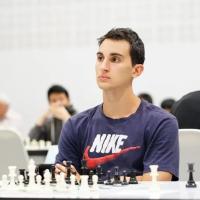
Данил Найдин - FIDE Master and Blitz Virtuoso
Meet Данил Найдин, better known in the chess world as DanilNajdin, a FIDE Master whose blitz speed could make even a bullet train jealous. Since bursting onto the scene in 2019 with a modest blitz rating of 1950, Danil has rocketed up to an astounding peak of 2724 in early 2024 — quite the quantum leap on the 64 squares!
Champion of the Lightning Realm
Danil’s blitz prowess is undeniable: over 1600 blitz games with a win rate hovering around 55%, and a downright legendary longest winning streak of 28 games. When the clock’s ticking down and others panic, Danil thrives, wielding tactical awareness with an 87% comeback rate and a perfect 100% win rate after losing a piece. Clearly, he’s the comeback kid of online chess battles.
Not Just a Blitz Blitzkrieg
But don’t pigeonhole him as just a speed demon! Danil’s rapid rating impresses as well, reaching 2480 at his peak, showing that his chess instincts hold steady even when the pace slows down. And in bullet, Danil has a stunning 67%+ win rate, deftly dodging losses and snatching victories at lightning speed.
Style and Psychology
Known for an endgame frequency of over 78%, Danil loves grinding out wins deep into the game, averaging around 72 moves for a victory. Playing with both White and Black pieces yields a solid 57% win rate, which is beautifully balanced. While his tilt factor suggests he’s human (only 6!), his early resignation rate is a humble 1.2%, proving he rarely throws in the towel without a fight.
Opponent Nemesis
DanilNajdin's battle log reads like a who's who of online chess: he’s undefeated against several opponents, occasionally hits a 100% win rate versus recent rivals like "paugab" and "pusionic," and clearly knows how to exploit weaknesses — though not everyone falls victim (looking at you, "jinxy2009" and "bluewizzard").
Off the board, Danil is presumably a thoughtful strategist and tactician with a taste for secret openings (“Top Secret” dominates his games) and a deep love for chess’s complexities. On the board, he’s the storm that others dread when the clock is winding down.
In summary: DanilNajdin is a relentless FIDE Master, blitz maestro, and a true general in the realm of fast chess — keep an eye on him as he continues to rattle the chess cosmos!
What you’re doing well in bullet games
In your recent bullet activity, you show a strong willingness to play active, tactical positions and to press your opponent when your pieces become active. You often pursue forcing moves and look for concrete ideas that create immediate pressure on the king or king-side weaknesses. When you can connect your rooks and bring a piece into an attack, you tend to keep your opponent on the back foot and push for sharp settles rather than drifting into passive lines.
Another strength is your ability to navigate a variety of openings and still stay engaged in the middlegame. Your opening choices reflect a readiness to enter tactical, open positions where you can use your initiative to create threats quickly.
Key areas to improve
- Time management under pressure: bullet games reward quick, precise decisions. Work on a quick, repeatable pre-move check ( threats, captures, and checks) so you don’t spend too long on non-forcing moves.
- King safety and positional awareness: in fast games, it’s easy to overlook back-rank or mating threats. Before committing to a sequence, do a quick scan for checks, captures, and threats against your own king.
- Endgame conversion: many bullet games end in simplified endings. Strengthen basic rook endings, king activity in endgames, and known drawing patterns so you can convert advantages or hold tight positions when ahead.
- Opening discipline for bullet: while variety is good, 1-2 reliable, forcing lines can reduce your decision overhead. Consider refining a small repertoire and sticking to it in short time controls.
- Avoid overextension in middlegames: in fast time-frame, it’s tempting to chase aggressive lines. Balance ambition with solid, principled development and incremental advantages (e.g., a small lead in space or a better piece activity) rather than sweeping tactical sacrifices that rely on precise calculation.
Openings performance snapshot and practical tips
Your openings show you perform well with several sharp, tactical structures and some solid, principled lines. A few findings to consider for bullet play:
- Your strongest results appear in lines that lead to clear plans and quick piece activity (for example, QGD-related setups and related forcing lines).
- Some openings in your dataset have lower win-rates (for example, Amar Gambit). In bullet, it’s often wiser to favor openings and lines that minimize risky improvisation and keep the position solid and easy to navigate under time pressure.
- Recommended approach: pick 1–2 openings for White that you already handle confidently (prefer lines with straightforward development and clear middlegame plans), and 1–2 Black replies that you know well to reduce decision fatigue.
Practical tips you can apply next session:
- Use a compact, forcing continuation in your first 2–3 moves to avoid getting into unclear positions under time pressure.
- Study short middlegame plans for your go-to openings so you can recognize good plans fast (for example, typical pawn breaks and piece maneuvers that exploit your opponent’s still-developing pieces).
- When you are ahead, look for simplifying moves that preserve your advantage and reduce counterplay rather than chasing speculative lines.
Training plan and practical drills
- Daily quick tactics: 15–20 minutes of puzzles focused on forcing moves, checks, and capture sequences to improve pattern recognition under time pressure.
- Endgame practice: 2–3 short sessions per week on rook endgames and king-and-pawn endings to improve conversion and drawing techniques in bullet games.
- Opening refinement: choose 1 white and 1 black mainline that you enjoy and study 2 typical middlegame plans for each. Create a one-page cheat sheet with common ideas and typical move-order tactics.
- Post-game review: after each bullet session, pick 1 or 2 critical moments (a misstep, missed tactic, or a risky decision) and write a short note on what you could do differently next time.
Possible practice stand-ins you can try
Use placeholders to replay or annotate your games for focused study, for example:
- Review a key tactical sequence from your last loss and annotate the moment you realized the tactic. Consider an alternative defensive idea you could have used.
- Annotate a position where you chose a forcing line. Was there a simpler route that leads to a clear, repetition-free win?
- Play a mini-bulk of 10 rapid games using a small, consistent opening repertoire and then a 15-minute review focusing on the openings’ middlegame plans.
Optional notes and placeholders
You can attach a sample game or PGN to illustrate the highlighted moments, for example:
🆚 Opponent Insights
| Most Played Opponents | ||
|---|---|---|
| speedrunaccount2023 | 15W / 7L / 3D | View Games |
| Никита Дергунов | 14W / 0L / 0D | View Games |
| Joan Trepat Herranz | 9W / 3L / 0D | View Games |
| novebg | 9W / 2L / 1D | View Games |
| petukhov_dmitry | 3W / 6L / 2D | View Games |
Rating
| Year | Bullet | Blitz | Rapid | Daily |
|---|---|---|---|---|
| 2025 | 2618 | |||
| 2024 | 2449 | 2646 | 2288 | |
| 2023 | 2501 | 2299 | ||
| 2022 | 2417 | 2402 | ||
| 2021 | 2482 | 2300 | ||
| 2020 | 2400 | 2414 | ||
| 2019 | 1448 | 1950 |
Stats by Year
| Year | White | Black | Moves |
|---|---|---|---|
| 2025 | 99W / 45L / 2D | 81W / 56L / 11D | 70.9 |
| 2024 | 125W / 79L / 24D | 132W / 77L / 21D | 79.5 |
| 2023 | 48W / 29L / 3D | 41W / 30L / 4D | 80.5 |
| 2022 | 37W / 29L / 8D | 37W / 34L / 4D | 79.2 |
| 2021 | 86W / 73L / 12D | 91W / 73L / 5D | 77.8 |
| 2020 | 145W / 95L / 25D | 141W / 105L / 20D | 76.2 |
| 2019 | 28W / 4L / 1D | 29W / 2L / 0D | 60.7 |
Openings: Most Played
| Blitz Opening | Games | Wins | Losses | Draws | Win Rate |
|---|---|---|---|---|---|
| Ruy Lopez: Brix Variation | 61 | 34 | 23 | 4 | 55.7% |
| Barnes Defense | 60 | 32 | 25 | 3 | 53.3% |
| Caro-Kann Defense: Exchange Variation | 45 | 21 | 22 | 2 | 46.7% |
| Modern | 43 | 23 | 18 | 2 | 53.5% |
| Amazon Attack | 39 | 20 | 18 | 1 | 51.3% |
| Australian Defense | 37 | 28 | 7 | 2 | 75.7% |
| Italian Game: Two Knights Defense | 34 | 24 | 8 | 2 | 70.6% |
| Blackburne Shilling Gambit | 34 | 12 | 20 | 2 | 35.3% |
| London System: Poisoned Pawn Variation | 31 | 20 | 8 | 3 | 64.5% |
| Amar Gambit | 30 | 23 | 5 | 2 | 76.7% |
| Rapid Opening | Games | Wins | Losses | Draws | Win Rate |
|---|---|---|---|---|---|
| Sicilian Defense | 4 | 3 | 1 | 0 | 75.0% |
| Amazon Attack | 3 | 1 | 2 | 0 | 33.3% |
| Sicilian Defense: O'Kelly Variation | 3 | 3 | 0 | 0 | 100.0% |
| Four Knights Game | 3 | 3 | 0 | 0 | 100.0% |
| Barnes Defense | 3 | 3 | 0 | 0 | 100.0% |
| Sicilian Defense: Closed | 3 | 3 | 0 | 0 | 100.0% |
| Ruy Lopez: Brix Variation | 2 | 1 | 1 | 0 | 50.0% |
| Sicilian Defense: Sozin Attack | 2 | 1 | 1 | 0 | 50.0% |
| London System: Poisoned Pawn Variation | 2 | 2 | 0 | 0 | 100.0% |
| Scandinavian Defense | 2 | 2 | 0 | 0 | 100.0% |
| Bullet Opening | Games | Wins | Losses | Draws | Win Rate |
|---|---|---|---|---|---|
| QGD: 3.Nc3 Bb4 | 8 | 7 | 1 | 0 | 87.5% |
| Scandinavian Defense | 7 | 4 | 1 | 2 | 57.1% |
| Australian Defense | 7 | 5 | 2 | 0 | 71.4% |
| Caro-Kann Defense | 6 | 4 | 1 | 1 | 66.7% |
| Barnes Defense | 6 | 5 | 1 | 0 | 83.3% |
| London System: Poisoned Pawn Variation | 5 | 4 | 1 | 0 | 80.0% |
| Amar Gambit | 5 | 2 | 3 | 0 | 40.0% |
| Alekhine Defense | 4 | 2 | 2 | 0 | 50.0% |
| Amazon Attack: Siberian Attack | 4 | 3 | 1 | 0 | 75.0% |
| Modern | 4 | 3 | 1 | 0 | 75.0% |
🔥 Streaks
| Streak | Longest | Current |
|---|---|---|
| Winning | 28 | 0 |
| Losing | 7 | 3 |