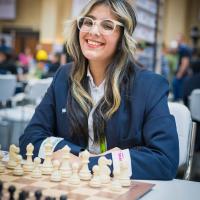

Hello María José Campos — quick summary
Nice recent form: you have clear strengths in opening preparation and converting winning positions. Your rating trend is steady and you've been winning with both tactical finishes and practical time pressure wins. Below I highlight what you do well and concrete, mobile-friendly steps to keep improving in rapid games.
What you are doing well
- Opening preparation pays off — you score especially well with English systems and have clean wins from Sicilian and Catalan-type structures. Keep reinforcing those lines. See the Catalan opening for ideas Catalan Opening.
- Practical play under pressure — you convert chances and finish actively. Several wins ended by tactical finishing or the opponent flagging.
- Good use of active rooks and queens in the middlegame — you often create threats on open files and use them to decide the game.
- You finish decisively when material or structural advantages appear. That shows good pattern recognition and willingness to press the attack.
Areas to improve (highest impact)
- Time management in rapid: several games show you dropping to very low clock times. Practice keeping a 10–20 second reserve for complex positions. If you find yourself repeating knight/king moves, use a quick plan instead of moving the same piece twice.
- Avoid aimless piece maneuvers. In your most recent win you spent several moves shuffling a knight and then had limited time to follow up. Try to ask "What is my immediate plan?" before the second similar move.
- Tactical calculation depth: you convert well but sometimes rely on opponents blunders or time. Build calculation routines: identify checks, captures, threats first, then candidate moves.
- Endgame technique: convert with less risk by improving basic king-and-pawn and rook endgames. A small conversion edge becomes a certainty with correct endgame knowledge.
Concrete next steps (practice plan for the week)
- Time-control drill: play 5 rapid games at your normal time but force yourself to keep at least 15 seconds on the clock after every 10 moves. Focus on quick, practical moves.
- Tactics routine: 10 tactics a day with increasing difficulty. After each exercise, write down the forcing sequence (checks/captures/threats) before executing — that builds the habit.
- One opening study session: pick your most successful opening (English or Catalan). Study 3 typical pawn breaks and 2 model endgames arising from it. Use model games to learn plans, not only moves.
- Endgame micro-session: 15–20 minutes on rook endgames and king+pawn basics. Aim to convert simple two-pawn or rook vs pawn endings without errors.
Small adjustments in games
- Before each move ask: "Is my opponent threatening anything immediate?" If yes, resolve the threat first. This avoids tactical oversights when low on time.
- When ahead in space or material, simplify gradually. Trading pieces when ahead reduces counterplay and time pressure stress.
- If you repeat a piece move (for example knight back and forth), check for a better square or a pawn break to justify the maneuver.
- Use short, safe moves (developing or improving piece) when down to 5–10 seconds rather than creating complications you cannot calculate.
Training drills (10–20 minutes each)
- Speed calculation: set a 5-minute mini-test of 6 positions where you list forcing moves only.
- Opening plan drill: pick one recent win and summarize 3 strategic goals for both sides in that opening.
- Endgame drill: practice Lucena and Philidor setups from both sides for 10 minutes.
- Blunder check: after every rapid game, spend 2 minutes scanning the last 10 moves for candidate tactics you missed.
Suggested resources
- Short tactics app for daily 10-minute sessions.
- One opening video on your favorite system, focus on typical middlegame plans rather than deep theory.
- One endgame primer or short video series covering rook endgames.
Review these recent games (click to open)
- Most recent win (good kingside pressure and conversion): Win vs maksudyusufzade — 2025-02-14
- Nice tactical finish by mate: Win vs larochita — 2024-02-05
- Clean positional conversion and active piece play: Win vs queenricochet — 2024-01-05
When you review each game, try this: list one critical moment where a different plan would have saved or gained time, and one simple improvement (a single square for a piece or an immediate pawn break).
Quick checklist for your next rapid session
- Start with a 5-minute tactics warmup.
- Play 3 rapid games, enforce a 15-second reserve in move 10 and onward.
- After each game, note one positional plan you used well and one time-management error to fix.
Final note
You're clearly improving and have a solid base in openings and practical conversion. Focus on time control and tightening your tactical routine. If you want, send 1 or 2 games you felt unsure about and I will give move-by-move suggestions and a short plan for the next session.