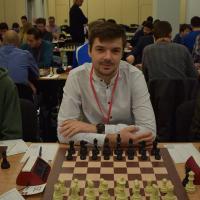
Artem Gilevych - The Intense International Master
Meet Artem Gilevych, known in the chess world by the handle metra93, an International Master with a penchant for turning the board into a battlefield where wits clash and patience is king. A title that speaks not only of skill but also of dedication, Artem’s journey through the ranks is a tale of grit and strategic audacity.
Since bursting onto the scene in 2012, Artem's performance has been a rollercoaster of epic proportions – except for the thrill, it's all about those precision moves on the 64 squares. With a peak blitz rating soaring to an impressive 2748 and a bullet best of 2744, Artem has proven speed is truly one of his virtues. He can strike faster than you can say “checkmate,” but beware, he’s got the endgame savvy to seal the deal just as well.
Known for a deeply analytical approach, he averages around 85 moves per game, showing a stubborn commitment to outmaneuvering opponents rather than quick, flashy wins. Early resignation? Rare as a unicorn in his games, highlighting his fighting spirit. His comeback rate from losing positions is a staggering 89%, suggesting that giving up is not in Artem's playbook, nor should it be in yours!
Style & Specialty
Artem’s opening choices reveal a fondness for rich, complicated positions. From the steadfast French Defense Winawer to the aggressive Queens Pawn Chigorin Variation, his repertoire is anything but predictable. When it comes to rapid and blitz games, the Scotch Game and French Winawer have been favored battlegrounds, achieving notable win rates up to 75% in some lines.
Sliding Through the Time Controls
- Blitz: 1694 wins, 1296 losses, 402 draws | Peak: 2748
- Bullet: 603 wins, 448 losses, 110 draws | Peak: 2744
- Rapid: 103 wins, 14 losses, 5 draws | Peak: 2572
- Daily: 17 wins, 7 losses, 2 draws | Peak: 1819
Recent Highlights
In 2025, Artem showed no signs of slowing down! His recent performance features a spectacular checkmate victory using the Scotch Game, where he executed an elegant mating net against Woodytaly. Expect fireworks when metra93 is on the board – quick, fierce, and quite possibly magical.
Outside of his well-honed tactical skills, Artem is commended for his consistency and tenacity, truly making him one of the formidable forces in modern chess. So whether it's a bullet storm or a marathon rapid showdown, Artem Gilevych is a player worth watching—and maybe trying to outwit (if you dare).
Quick summary
Nice run in recent 3‑minute games — you keep creating dangerous kingside pressure and you convert active piece play into wins. At the same time a pattern shows up: when your opponent opens a kingside pawn storm or sacrifices on your king side you sometimes underestimate the long‑term threat of a passed pawn or queen infiltration. Below are focused, practical recommendations to keep the aggression that works and tighten the places that cost you games.
What you’re doing well
- Creating direct attacking chances: you consistently generate threats against the opponent’s king (pawn storms, active queens/rooks) and punish passive defense.
- Piece activity over material: you routinely prioritize open files and piece coordination, which produces practical chances in blitz.
- Opening variety and practical preparation: you use sharp lines (and some offbeat systems) to steer opponents into unfamiliar positions — this is reflected in your strong win rates in several openings like the Amazon Attack and Nimzo-Larsen Attack.
- Time usage: in most games you keep sufficient time to find tactical shots and finish cleanly — important in 3|0 play.
Key areas to improve
- Defending against pawn storms and advancing g/h pawns: in the most recent game vs beppe899 you allowed a passed g‑pawn to reach g2 with decisive effect. When the opponent pushes pawns toward your king, evaluate immediate blocking, piece trades that defuse the pawn, and king safety moves first — don’t hope the pawn will stall.
- Prophylaxis and flight squares for your king: when you commit to an aggressive posture (castling short and pushing pawns), check for escape squares and tactical checks along diagonals and files that could undo your attack.
- Selective simplification: sometimes you exchange into positions that let your opponent get counterplay (queens or knights landing on strong outposts). Before trading, ask whether the simplified position improves your target squares or their counterplay.
- Opening weaknesses in certain long theoretical lines: some variations (e.g., the Tarrasch/Botvinnik lines in your dataset) give you trouble. Either avoid sharp theoretical battlegrounds you don’t want to memorize or study the typical plans more deeply.
Concrete drills & study plan (weekly, ~4 sessions)
- Daily 10–15 min tactical warmup (mixed motifs, focus on mating nets, pawn breakthroughs and sacrifices). Use short sets so your pattern recognition improves under time pressure.
- 2× per week: 20–30 min game review. Pick one recent loss and one win (preferably the same opening) and do a short engine + human check: identify the critical moment and write 1‑2 concrete alternatives you missed.
- 1× per week: 20 min opening refresh. For lines you play a lot (like your French systems), review one typical pawn break and one typical end structure — not move‑by‑move theory but the plan and key squares.
- Blitz practice: play a 10‑game blitz session, but after every loss spend one minute to note the single reason you lost (time, tactic, structural weakness, king safety). This trains quick error diagnosis.
Practical tips to use during blitz
- When you see an advancing enemy pawn storm aimed at your king, stop and ask three quick questions: can I challenge the base pawn, can I trade to remove the pawn’s protector, do I need to change king shelter? If none of these help, prioritize king safety even at the cost of one tempo.
- Before sacrificing or opening a file, verify the opponent has no quiet defense that leaves you with a lost endgame. In blitz it’s easy to overlook a defensive resource that neutralizes your attack.
- Use small prophylactic moves (king step, rook behind, knight redeploy) when you sense a counterbreak is brewing; these moves often buy you one extra tempo that matters in tactical sequences.
- Keep an eye on the opponent’s passed pawns — if they appear, calculate whether you can stop them by blockade or piece trade. Passed pawn + open file + queen infiltration is the common loss pattern you had recently.
Notable recent win (study this critical position)
Below is one of your recent wins — replay it and stop at each moment where your opponent made a pawn push or piece sacrifice. Ask what the defensive resource was and whether you could have improved your conversion.
Opponent: beppe899
Short-term goals for your next 20 games
- Reduce losses from pawn‑storm/blocked‑king scenarios by 30%: when you lose, identify whether it was due to a pawn break or a queen infiltration and note it.
- Convert at least one position per session where you have a clear material or structural advantage — practice the calm finishing technique (trade rooks when king is safe, centralize king in endgames).
- Strengthen one weak opening line: pick the single opening with the lowest win rate in your frequent repertoire and spend two 20‑minute sessions studying its main ideas (not all moves).
Parting note
You already have the core skills for fast pressure and tactical wins. Tightening defense against pawn storms and doing focused post‑game checks will convert more of your good positions into wins — especially in blitz where one missed prophylactic move can flip the result. If you want, I can analyze one specific loss with move‑by‑move commentary or make a short 4‑week training calendar tailored to the openings you play most.
🆚 Opponent Insights
| Most Played Opponents | ||
|---|---|---|
| pushpanna | 27W / 16L / 9D | View Games |
| beppe899 | 38W / 5L / 2D | View Games |
| stereotipo2015 | 19W / 18L / 5D | View Games |
| Zbigniew Pakleza | 12W / 23L / 3D | View Games |
| bettermintownschess | 18W / 8L / 9D | View Games |
Rating
| Year | Bullet | Blitz | Rapid | Daily |
|---|---|---|---|---|
| 2025 | 2706 | 2732 | 2185 | 1838 |
| 2024 | 2730 | 2732 | 2185 | 1818 |
| 2023 | 2748 | 2185 | ||
| 2022 | 2736 | 2748 | 2178 | 1818 |
| 2021 | 2654 | 2700 | 2171 | 1772 |
| 2020 | 2600 | 2700 | 2168 | 1377 |
| 2019 | 2434 | 2598 | 2364 | 1167 |
| 2018 | 2556 | 2477 | 2000 | |
| 2017 | 2511 | 2328 | 2000 | |
| 2016 | 2440 | 2259 | ||
| 2015 | 2079 | 2303 | ||
| 2014 | 1040 | |||
| 2012 | 2151 | 2075 | 1069 |
Stats by Year
| Year | White | Black | Moves |
|---|---|---|---|
| 2025 | 20W / 3L / 0D | 10W / 3L / 1D | 65.6 |
| 2024 | 16W / 1L / 2D | 15W / 6L / 2D | 75.6 |
| 2023 | 12W / 0L / 0D | 8W / 0L / 0D | 52.6 |
| 2022 | 15W / 1L / 0D | 13W / 2L / 0D | 75.0 |
| 2021 | 19W / 3L / 0D | 15W / 5L / 3D | 65.3 |
| 2020 | 109W / 51L / 24D | 99W / 56L / 18D | 84.8 |
| 2019 | 250W / 179L / 56D | 236W / 192L / 50D | 90.3 |
| 2018 | 473W / 367L / 120D | 442W / 406L / 132D | 92.3 |
| 2017 | 99W / 78L / 24D | 95W / 81L / 29D | 83.9 |
| 2016 | 126W / 90L / 13D | 108W / 101L / 15D | 85.8 |
| 2015 | 68W / 41L / 12D | 56W / 55L / 11D | 90.0 |
| 2014 | 1W / 2L / 0D | 1W / 3L / 0D | 37.0 |
| 2012 | 68W / 19L / 6D | 62W / 24L / 2D | 78.7 |
Openings: Most Played
| Rapid Opening | Games | Wins | Losses | Draws | Win Rate |
|---|---|---|---|---|---|
| Scotch Game | 11 | 11 | 0 | 0 | 100.0% |
| Caro-Kann Defense | 10 | 10 | 0 | 0 | 100.0% |
| Alekhine Defense | 7 | 6 | 0 | 1 | 85.7% |
| Barnes Defense | 5 | 4 | 1 | 0 | 80.0% |
| Blackburne Shilling Gambit | 5 | 5 | 0 | 0 | 100.0% |
| Scandinavian Defense | 4 | 3 | 1 | 0 | 75.0% |
| Amazon Attack: Siberian Attack | 4 | 3 | 1 | 0 | 75.0% |
| Sicilian Defense: Alapin Variation | 4 | 4 | 0 | 0 | 100.0% |
| Amazon Attack | 4 | 2 | 0 | 2 | 50.0% |
| QGA: 3.e3 c5 | 4 | 4 | 0 | 0 | 100.0% |
| Daily Opening | Games | Wins | Losses | Draws | Win Rate |
|---|---|---|---|---|---|
| Amazon Attack: Siberian Attack | 2 | 1 | 0 | 1 | 50.0% |
| Sicilian Defense: O'Kelly Variation | 2 | 2 | 0 | 0 | 100.0% |
| Barnes Defense | 2 | 1 | 1 | 0 | 50.0% |
| QGA: 4.e3 a6 | 2 | 1 | 1 | 0 | 50.0% |
| Sicilian Defense: Alapin Variation | 1 | 1 | 0 | 0 | 100.0% |
| Caro-Kann Defense | 1 | 1 | 0 | 0 | 100.0% |
| Ruy Lopez: Bird's Defense Deferred | 1 | 1 | 0 | 0 | 100.0% |
| Italian Game: Two Knights Defense | 1 | 1 | 0 | 0 | 100.0% |
| Döry Defense | 1 | 1 | 0 | 0 | 100.0% |
| Ruy Lopez: Exchange Variation | 1 | 1 | 0 | 0 | 100.0% |
| Bullet Opening | Games | Wins | Losses | Draws | Win Rate |
|---|---|---|---|---|---|
| Amar Gambit | 121 | 72 | 32 | 17 | 59.5% |
| Colle System: Rhamphorhynchus Variation | 63 | 26 | 28 | 9 | 41.3% |
| Australian Defense | 56 | 28 | 23 | 5 | 50.0% |
| Hungarian Opening: Wiedenhagen-Beta Gambit | 55 | 34 | 15 | 6 | 61.8% |
| French Defense | 49 | 26 | 15 | 8 | 53.1% |
| Nimzo-Larsen Attack | 47 | 19 | 23 | 5 | 40.4% |
| King's Indian Attack | 43 | 16 | 23 | 4 | 37.2% |
| Modern | 30 | 19 | 11 | 0 | 63.3% |
| French Defense: Classical Variation, Svenonius Variation | 29 | 10 | 17 | 2 | 34.5% |
| Döry Defense | 29 | 15 | 12 | 2 | 51.7% |
| Blitz Opening | Games | Wins | Losses | Draws | Win Rate |
|---|---|---|---|---|---|
| French Defense: Winawer Variation, Advance Variation | 131 | 60 | 56 | 15 | 45.8% |
| French Defense | 126 | 58 | 58 | 10 | 46.0% |
| Barnes Defense | 112 | 55 | 46 | 11 | 49.1% |
| Amazon Attack | 79 | 44 | 27 | 8 | 55.7% |
| French Defense: Tarrasch Variation, Botvinnik Variation | 74 | 22 | 45 | 7 | 29.7% |
| Australian Defense | 65 | 30 | 26 | 9 | 46.1% |
| Amar Gambit | 59 | 22 | 32 | 5 | 37.3% |
| Nimzo-Larsen Attack | 59 | 30 | 21 | 8 | 50.9% |
| London System: Poisoned Pawn Variation | 58 | 28 | 24 | 6 | 48.3% |
| French Defense: Exchange Variation | 55 | 29 | 14 | 12 | 52.7% |
🔥 Streaks
| Streak | Longest | Current |
|---|---|---|
| Winning | 45 | 6 |
| Losing | 12 | 0 |