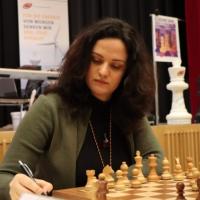
Hi Kateryna!
Great job keeping an active tournament schedule and steadily pushing your rating ceiling up to 2201 (2020-12-01). The data shows that you put in the hours – your activity curve (
) proves it – and the effort is paying off. Below is some focused feedback based on your two most recent decisive games against E K.1. What you’re already doing very well
- Dynamic play with Black. In your latest victory you converted a sharp Nimzo-Indian into a direct mating attack.
• 11…b6! kept the c5–knight out and prepared …c5 ideas.
• 18…Bxf3 & 19…Qg5+!! seized the initiative and never let go. - Practical time management. Even in tactical complications you maintained a 1–2 minute clock edge, forcing your opponent to calculate under pressure.
- End-game conversion skills. After the queens came off (move 25) you handled the R+P ending efficiently, coordinating rooks and knights to restrict counterplay.
2. Biggest improvement opportunities
- Early-gambit evaluation. In your recent loss (Giuoco Piano – Dubov Gambit) you accepted a dangerous pawn on move 8 (8…dxc4) without completing development.
Result: your king was stuck on the queenside and you were mated on move 35.
➜ Rule of thumb: if accepting a pawn leaves both bishops un-developed or king in the centre, decline or delay. - Piece coordination vs. loose pawns. Several of your losses feature a knight or rook stranded on the rim while the opponent invades the centre (see moves 33-41 of the loss). Train “least active piece first” thinking in every position.
- End-game stubbornness. A couple of games end by resignation while material is only −1. Before clicking “Resign” ask: “Can I reach a fortress or perpetual?” Saving even 10 % of lost positions will lift your rating significantly.
3. Key moments to replay
Click to view annotated snippets
A) Your win (Black) – controlling the dark squares
Coaching tip: Notice how every move added a threat and reduced your opponent’s options. Strive for the same “two-purpose” moves when ahead.
B) Your loss (Black) – when greed backfires
Coaching tip: By move 12 White has four active pieces vs. your undeveloped queenside. Next time consider 8…Bb6 and rapid castling instead.
4. Short-term study plan (2 weeks)
- Opening hygiene (30 min/day). Drill one safe antidote vs. the Dubov Gambit and vs. 1.Nf3 g3 setups. Use a database or Chess.com’s explorer.
- Tactics (15 min/day). Mix “simulated blunders” (set timer to 30 sec) with deeper calculation drills (5 min/position) to balance speed and depth.
- Rollback review (after each session). Win or lose, spend 5 min marking “first move I’d change” – the quickest path to pattern recognition.
5. Long-term themes (next quarter)
- Upgrade your understanding of structure-transforms – especially pawn sacrifices for activity. Isolated Queen’s Pawn and hanging pawns positions come up often in your games.
- Sharpen rook-endgame technique: study Vancura and Lucena positions; they appear frequently after your queen trades.
6. Motivation corner
Remember: progress is rarely linear. Plateaus usually precede rating jumps, so treat every frustrating loss as data, not identity. Keep the board busy and the learning curve steep – I’m confident you’ll break the next rating milestone soon!
Good luck, and feel free to send your next set of games for further analysis.