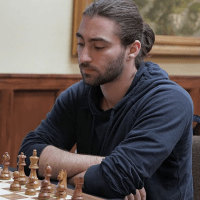
Alex Ostrovskiy – International Master Extraordinaire
Alex Ostrovskiy, known in the chess world by the enigmatic username AlexOstrovskiy, is an International Master who plays blitz and bullet chess like a caffeinated grandmaster. With a peak blitz rating soaring to 2882 in late 2021 and bullet reaching an astounding 2896 in 2020, Alex’s mouse clicks are as swift as their strategic thinking is sharp.
A Career of Peaks, Pawns, and Paw-ssibilities
Emerging as a formidable player around 2018, Alex developed a penchant for rapidfire face-offs, racking up thousands of games in both blitz and bullet formats (over 4,000 blitz games and nearly 3,850 bullet games!). Their win rate in blitz hovers a respectable 54.89%, proving time and again that the clock is an ally, not a nemesis.
Playing Style & Psychological Prowess
- Patient Endgame Strategist: With an endgame frequency of over 81% and average moves of 74 per win, Alex treats the board like a chess marathon, outlasting opponents in grueling final battles.
- Tactical Houdini: Boasting an 82.2% comeback rate and a cool-headed 51.77% win rate even after losing a piece, Alex is the master of turning tables when others might throw in the towel.
- Early Resigned? Not Often: A low early resignation rate of just 0.58% suggests Alex fights till the very last pawn is sacrificed.
Most Recent Triumphs & Defeats
Alex’s latest games depict a clever master maneuvering the often tricky Sicilian Defense with flair. In a recent match, employing the Closed Sicilian Traditional Line (ECO B23), Alex secured a win by resignation after a dazzling sequence culminating in a knight fork that left the opponent no choice but to concede.
Though even masters have their off days: a recent loss came on time in a Scandinavian Defense battle, reminding us that in chess, every second counts!
Interesting Tidbits
Alex has held winning streaks as long as 23 games, proving they can focus like a laser for quite some time – but fear a losing streak? Only up to 12 games before bouncing back with renewed vigor.
Despite the intense competition, Alex’s peak bullet and blitz ratings flirt dangerously close to Grandmaster territory, making one wonder if the title of GM is just around the corner – and if so, watch out, chess world!
In Summary
Alex Ostrovskiy stands as a shining example of dedication, agility, and cheeky tactical flourish in the modern chess scene. Whether it’s blitz, bullet, or daily games, Alex never fails to entertain, outwit, and inspire – all while possibly sipping some strong coffee and chuckling at opponents trying to keep up.
For chess fans looking to study a player whose victories are as quick as lightning moves and whose losses just fuel the next comeback, Alex is a grandmaster in the making and a formidable opponent on any board.
Quick summary
Nice run — you converted cleanly in complicated endgames and repeatedly turned small advantages into wins. A few games ended on the clock, so clock management is still a leverage point. Below I highlight what you did well, recurring weaknesses from the sample games, and a compact training plan so your bullet play becomes more reliable (not just faster).
Game highlight
Replay the key win vs judenyc (you as White). Study the transition from middlegame pressure into a passed-pawn endgame and the final conversion.
Interactive replay:
What you're doing well
- Endgame technique: you convert passed pawns and king activity reliably — the highlighted win shows clean promotion play and precise rook/pawn handling.
- Opening preparation: your repertoire is producing practical games — you've got strong win rates in several systems (Nimzo‑Larsen, Australian, Caro‑Kann, French).
- Tactical awareness: you find the concrete tactical continuations that win material or force simplification in your favour.
- Practical play under pressure: you create messes that cause higher‑rated opponents to mis-time the clock — useful in bullet when used ethically and selectively.
Recurring weaknesses & patterns to fix
- Clock reliance: several wins were on time rather than checkmate or resignation. Don’t rely on flags — make simpler, faster plans earlier so you’re not in severe time trouble late.
- Time allocation: you sometimes spend too long in quiet positions and then scramble in tactical or sharp moments. In bullet, keep a baseline of ~5–8 seconds for simple moves and reserve calculation time for forcing lines.
- Pawn/structure care vs knight invasions: in a loss you allowed the opponent’s knights to jump into b3/… and cause forks and targets. Watch light squares and avoid unnecessary pawn pushes that create outposts for enemy knights.
- Premoves in complex positions: pre‑moves are great for quiet captures, dangerous in unclear positions — stop pre‑moving when there’s tactical ambiguity.
- Simplification timing: sometimes trades happen one move later than ideal. If you have the superior endgame, exchange down earlier to reduce tactical counterplay.
Concrete bullet tips (apply next session)
- Start each game with a two‑move plan: develop a minor piece, play a pawn break or king safety move. If the plan is simple, move fast.
- When ahead, simplify immediately if opponent has counterplay — trade queens/rooks when it reduces their active pieces and your passed pawn will decide the game.
- If you’re below 10 seconds: switch to "no thinking" mode — play safe, natural moves (develop, recapture, defend) and avoid speculative sac or long calculations.
- Use the increment (if available) to convert: keep moves simple to build time bank; avoid multiple long think sessions in the first 10 moves.
- Mark two spots on the board mentally: your king’s escape square(s) and the opponent’s knight outposts. If either is threatened, deal with it immediately.
Short practice plan (daily / weekly)
- Daily (15–25 minutes): 3 bullet sessions of 5 minutes focusing purely on speed — do NOT use long thinks. Objective: build reflexes for your two‑move opening plans.
- Daily (10 minutes): Tactics trainer — 20 puzzles emphasizing forks, pins, back‑rank and knight jumps (these patterns cost you time or material).
- 3× week (20 minutes): Endgame drills — king + pawn vs king, rook + pawn endgames and queen vs rook conversions. Practice converting with little time on the clock.
- Weekly (30–60 minutes): One rapid game or analyzed bullet — go through 3 recent games, annotate critical decisions and decide whether you should have simplified or kept tension.
Immediate checklist before your next bullet session
- Review your two main reply systems: Modern Defense and Reti Opening — decide your go‑to quick plans for each.
- Set a time‑budget: first 10 moves = 5–8 seconds each; reserve extra time for tactics on moves 11–25.
- Turn off aggressive pre‑moves in unclear positions; only pre‑move obvious recaptures or pawn pushes with no tactic.
- After any game lost on time, add a one‑line note: “why did I spend so long here?” — that builds awareness fast.
Next steps (3‑week plan)
- Week 1 — Habits: enforce the time budget and no pre‑moves in messy positions; do daily tactics and a 5‑minute speed block.
- Week 2 — Patterns: focus 3 sessions on knight outpost awareness and pawn‑structure fixes; practice simplifying when a clear endgame appears.
- Week 3 — Convert: play 10 serious rapid games and 30 tactical puzzles; review 10 bullet wins/losses to confirm improvements in time use and decision timing.
Parting note
You already have the essentials: strong opening prep, sharp tactics, and the ability to convert passed pawns. The biggest gains in bullet will come from disciplined time management and clearer simplification decisions. If you want, I can:
- Make a 2‑move opening cheat sheet for your top 4 lines.
- Generate 30 tactical puzzles tailored to patterns you miss (knight forks/back‑rank/intermediate checks).
- Annotate 2 of the recent games with targeted alternatives to save time or simplify earlier.
Which of the three would you like me to prepare first?
🆚 Opponent Insights
| Recent Opponents | ||
|---|---|---|
| oshriejreyes | 1W / 0L / 0D | View |
| WilderSeerobb | 1W / 0L / 0D | View |
| better-than-you32 | 0W / 0L / 1D | View |
| Vitaliy Bernadskiy | 0W / 6L / 0D | View |
| Evgenij Shuvalov | 4W / 2L / 1D | View |
| hugo-berthier | 2W / 0L / 0D | View |
| hellooitsyou | 0W / 1L / 0D | View |
| surya1011 | 1W / 0L / 0D | View |
| Henry Soto Hernandez | 1W / 1L / 0D | View |
| Juan Cruz Arias | 0W / 1L / 1D | View |
| Most Played Opponents | ||
|---|---|---|
| Levy Rozman | 58W / 137L / 11D | View Games |
| Brian Arthur | 74W / 18L / 2D | View Games |
| eightbyeightchess | 57W / 21L / 4D | View Games |
| Dachey Lin | 28W / 46L / 3D | View Games |
| don_champinon | 39W / 25L / 9D | View Games |
Rating
| Year | Bullet | Blitz | Rapid | Daily |
|---|---|---|---|---|
| 2025 | 2639 | 2778 | ||
| 2024 | 2715 | |||
| 2023 | 2639 | 2785 | ||
| 2022 | 2702 | 2724 | ||
| 2021 | 2736 | 2851 | 2000 | |
| 2020 | 2741 | 2810 | 1800 | |
| 2019 | 2566 | 2588 | 1800 | |
| 2018 | 2424 | 2322 |
Stats by Year
| Year | White | Black | Moves |
|---|---|---|---|
| 2025 | 132W / 80L / 21D | 119W / 96L / 15D | 82.1 |
| 2024 | 180W / 112L / 20D | 150W / 137L / 24D | 81.9 |
| 2023 | 148W / 69L / 15D | 107W / 114L / 21D | 86.4 |
| 2022 | 64W / 37L / 2D | 65W / 29L / 7D | 89.3 |
| 2021 | 102W / 61L / 12D | 107W / 53L / 11D | 83.9 |
| 2020 | 1195W / 790L / 140D | 1110W / 889L / 138D | 78.9 |
| 2019 | 91W / 68L / 16D | 100W / 67L / 9D | 78.6 |
| 2018 | 26W / 13L / 4D | 25W / 15L / 2D | 77.5 |
Openings: Most Played
| Blitz Opening | Games | Wins | Losses | Draws | Win Rate |
|---|---|---|---|---|---|
| Amazon Attack: Siberian Attack | 579 | 317 | 215 | 47 | 54.8% |
| Caro-Kann Defense | 266 | 137 | 105 | 24 | 51.5% |
| Sicilian Defense: Closed | 234 | 149 | 77 | 8 | 63.7% |
| Scandinavian Defense | 211 | 120 | 79 | 12 | 56.9% |
| Australian Defense | 176 | 99 | 64 | 13 | 56.2% |
| Amazon Attack | 152 | 91 | 54 | 7 | 59.9% |
| Caro-Kann Defense: Exchange Variation | 135 | 78 | 47 | 10 | 57.8% |
| Sicilian Defense | 127 | 66 | 57 | 4 | 52.0% |
| London System: Poisoned Pawn Variation | 97 | 57 | 30 | 10 | 58.8% |
| French Defense | 94 | 54 | 33 | 7 | 57.5% |
| Bullet Opening | Games | Wins | Losses | Draws | Win Rate |
|---|---|---|---|---|---|
| Nimzo-Larsen Attack | 381 | 209 | 148 | 24 | 54.9% |
| Australian Defense | 255 | 157 | 86 | 12 | 61.6% |
| Amazon Attack: Siberian Attack | 254 | 121 | 120 | 13 | 47.6% |
| Caro-Kann Defense | 251 | 126 | 103 | 22 | 50.2% |
| Amar Gambit | 229 | 140 | 80 | 9 | 61.1% |
| Barnes Defense | 190 | 98 | 85 | 7 | 51.6% |
| Colle System: Rhamphorhynchus Variation | 130 | 58 | 64 | 8 | 44.6% |
| Amazon Attack | 110 | 66 | 39 | 5 | 60.0% |
| French Defense | 99 | 61 | 34 | 4 | 61.6% |
| Sicilian Defense | 81 | 50 | 28 | 3 | 61.7% |
| Daily Opening | Games | Wins | Losses | Draws | Win Rate |
|---|---|---|---|---|---|
| Barnes Defense | 1 | 1 | 0 | 0 | 100.0% |
| Rapid Opening | Games | Wins | Losses | Draws | Win Rate |
|---|---|---|---|---|---|
| Sicilian Defense | 1 | 0 | 0 | 1 | 0.0% |
| King's Indian Defense | 1 | 0 | 1 | 0 | 0.0% |
| Amar Gambit | 1 | 1 | 0 | 0 | 100.0% |
| Nimzo-Larsen Attack | 1 | 0 | 1 | 0 | 0.0% |
🔥 Streaks
| Streak | Longest | Current |
|---|---|---|
| Winning | 23 | 2 |
| Losing | 12 | 0 |