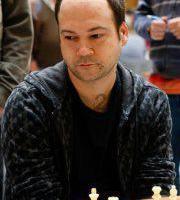
Avatar of Carlos Barrero Garcia

Carlos Barrero Garcia IM

Username: apuntando

Location: Huelva, Spain

Playing Since: 2012-07-10 (Active)

Wow Factor: ♟♟♟♟♟♟

Chess.com

Blitz: 2505
6692W / 5237L / 458D
Bullet: 1793
4W / 8L / 0D

Carlos Barrero Garcia – The International Master with a Tactical Twist

Meet Carlos Barrero Garcia, known in the chess world by the handle apuntando. Awarded the prestigious title of International Master by FIDE, Carlos is a formidable force on the 64 squares, blending strategic depth with occasional daring escapes that would make Houdini proud.

Since 2012, Carlos has electrified the blitz scene, peaking at an impressive 2297 rating in May 2016 — a number that sends shivers down the spines of opponents and fuel to his love for rapid-fire decisions. His average blitz rating hovers consistently above 2100, demonstrating both remarkable skill and endurance through thousands of games.

While bullet chess has been less of a playground for him, with a peak rating around 1861, Carlos prefers to savor each move rather than blitz through in a blur. His daily chess rating may seem modest at 800, but then again, who really plays daily chess seriously anymore?

A glance at Carlos’ win/loss record tells a story of resilience: over 6,500 wins in blitz matches, boasting a strong 54% average win rate with his trusted "Top Secret" openings strategy — which may or may not be just a cheeky cloak to keep his opponents guessing. And indeed, his comeback rate after losing a piece is an astonishing 80%, proving that giving up is never in his repertoire.

Carlos favors the late game, squeezing victories out of complex endgames with an average winning game spanning about 64 moves — patience is a virtue, and Carlos has it in spades. His psychological tilt factor being relatively low at 10 suggests calm nerves, although his longest winning streak sits at a gallant 18 games, and his losing streak at a respectful 10.

He shines brightest between 3 pm and 4 pm, and if you challenge him then, prepare for a battle of wits complicated by a mix of energy and precision that few can tolerate. Carlos proves that chess isn’t only about brute strength or brainpower – it’s also about timing.

Off the board, he’s known for his sense of humor and good-natured banter, often joking that his favorite opening is “Coffee & Patience,” a sly nod both to his style and stamina.

Most Recent Masterstroke

One of Carlos' recent standout victories came with a smooth handling of the Caro-Kann Defense, forcing his opponent to resign in a brilliantly fought battle on December 16, 2017. Using pressure, tactical pawn breaks, and precise rook placement, he left no doubt — when Carlos says "checkmate," it’s not a request.

Replay the winning game if you dare.

In a nutshell, Carlos Barrero Garcia is the International Master who can juggle speed, patience, and tactics all in one daring package. He proves daily that mastering chess is as much about wit and spirit as it is about the pieces on the board.


Coach Chesswick's Profile Photo
Coach Chesswick

Quick summary

Carlos — good run recently: you're converting winning chances and mixing solid opening choices with practical, tactical play. Below I highlight what you did well in your recent blitz games, recurring leaks to fix, and a concrete 4‑week practice plan to push your blitz score up.

What you're doing well

  • Opening preparation: you reach comfortable middlegames from solid systems like the Caro-Kann Defense and French-type setups. That gives you a reliable structure to play for advantage quickly.
  • Tactical alertness in sharp moments: in your recent wins you found energetic knight and rook ideas to create decisive threats (example: the win where you finished with a forcing rook invasion — review:
    ).
  • Practical time use: you generally keep enough clock for the middlegame and use the increment to calculate critical sequences — a big plus in blitz.
  • Attacking instinct: you push kingside pawn storms and knight infiltrations at the right moments (example: the game where Ng7 + f5 created decisive pressure).

Recurring weaknesses to fix

  • King safety and coordination: a few times (especially in tense middlegames) your king ended up exposed or you delayed connecting rooks. In one loss the opponent exploited a back‑rank / infiltration idea after your rook got stuck on the edge — review that sequence:
    .
  • Occasional tunnel vision: when you see one plan (e.g., pawn storm or piece sacrifice) you sometimes miss simple defensive resources for the opponent — pause a beat when the position becomes forcing and check opponent replies.
  • Handling sacrifices and simplifications: when you have the initiative you sometimes allow counterplay by not completing the simplification (exchanging the right pieces), which gives the opponent tactical chances.

Concrete habits to adopt (immediate)

  • Rule of thumb for king safety: if you castle short and start a flank attack, keep at least one rook connected (or be ready to create luft or an escape square). Ask: "if my opponent gives a check here, do I have to lose material?"
  • Before making forcing-looking moves, force yourself to ask: "What is my opponent's best reply?" — visualise two replies quickly in your head. If you can't, spend a little time — these are the moves that swing blitz games.
  • When ahead in material: simplify into an endgame or liquidate one attacking piece — convert rather than keep complications unless you see a clear finish.
  • When down on the clock: avoid speculative sac moves unless they are truly forcing. Opt for checks and captures if you must play quickly.

Tactical and calculation drills

  • Daily: 20–30 tactics on mixed difficulty (focus on mates, forks, pins, deflections). Time each batch to simulate blitz pressure.
  • Visualization drill (3× week): set up a quiet position and calculate a 4‑move variation in your head, then check on the board.
  • Blitz puzzle rush: 10 minutes at fast time to train speed, then 10 minutes slower with explanation for mistakes.

Opening work (practical, 15–30 minutes)

  • Keep the main lines you play but add one "anti‑trap" line per opening: for example, in the Caro-Kann Defense and French systems review typical traps your opponents use and how to neutralize them.
  • Build 5 move playlists: memorize typical middlegame plans arising from your openings (pawn breaks, ideal squares). This reduces calculation load in blitz.
  • Study one opponent-style idea per week — e.g., how to respond when White plays an early Bg5 vs your Caro‑Kann.

Endgame / conversion checklist

  • If ahead by a pawn: exchange into a rook + pawn ending when safe; keep the king active.
  • Avoid "passive winning" — if you are up, watch out for counterplay along open files and long diagonals.
  • Practice simple theoretical wins (king + rook vs king, rook + pawn endings) so you convert instinctively under time pressure.

4‑week blitz improvement plan

  • Week 1 — Tactics and calculation: 30 min/day tactics, 3 visualization sessions, review 10 recent games for missed tactics.
  • Week 2 — Practical openings & model middlegames: 20 min opening review + 20 min of thematic middlegame studies from your favorite systems.
  • Week 3 — Endgames & conversion: 30–40 min practicing key endgames, plus 2 blitz sessions where your goal is to convert +1 positions.
  • Week 4 — Integration: 5 blitz games/day, post‑mortem 15–20 minutes each, focus on repeating mistakes, keep a short log of recurring errors.

Game study suggestions (use these examples)

  • Study your recent loss vs Francesco Bentivegna — the final sequence shows how a back‑rank/infiltration idea can finish the game. Replay it here and try to find defensive resources for Black:
  • Replay a recent win (the game where you used Ng7 + f5 style attack) and mark the turning points — what made the opponent's position collapse? Use that pattern again in your blitz games: lexcorp1234

Practical blitz tips (one-line reminders)

  • When you see a forcing tactic, pause for a second and verify the opponent's best reply.
  • Prefer simplifying to an easily winning endgame when materially ahead in blitz.
  • Use pre-moves sparingly — only when there's no counterplay.
  • If the position is unclear, steer to low‑risk moves that keep options open (develop, centralize, exchange a piece if it reduces opponent threats).

Final encouragement

Your rating trend and opening performance show you're doing many things right. Tightening up king safety, sharpening the habit of checking opponent replies, and focused tactics/endgame drills will turn more close games into wins. Keep a short post‑game note (1–2 lines) about "why I won / why I lost" — that alone accelerates improvement in blitz.

Want a short personalized training calendar I can generate for you (with daily tasks and links to puzzles)? Reply and I'll make a 4‑week calendar tailored to how many minutes per day you want to train.


🆚 Opponent Insights

Recent Opponents
javierrdguez 0W / 1L / 0D View
romankramargel 2W / 1L / 0D View
wilenczyk 2W / 0L / 0D View
arnau-h 1W / 0L / 0D View
hyuaz 1W / 0L / 0D View
v-andras 1W / 1L / 0D View
vedantvarasada 0W / 1L / 0D View
amaramos 0W / 1L / 0D View
tough 0W / 1L / 0D View
m0usesiip 0W / 1L / 0D View
Most Played Opponents
aloysius Moore 36W / 13L / 1D View Games
Eduardo Ortiz 19W / 12L / 1D View Games
Henrik Dalsgaard 12W / 14L / 1D View Games
marinstrasni 9W / 13L / 3D View Games
Dirk Floor 10W / 11L / 1D View Games

Rating

Year Bullet Blitz Rapid Daily
2025 2498
2018 2213
2017 2213 800
2016 1643 2208
2015 1488 1987
2014 1735 2168
2013 1991
2012 2017
Rating by Year2012201320142015201620172018202524981488YearRatingBulletBlitz

Stats by Year

Year White Black Moves
2025 75W / 36L / 3D 68W / 39L / 15D 73.3
2018 0W / 0L / 0D 0W / 1L / 0D 63.0
2017 113W / 79L / 8D 105W / 94L / 7D 66.0
2016 1166W / 788L / 75D 1063W / 888L / 93D 66.1
2015 1035W / 843L / 54D 962W / 914L / 60D 66.1
2014 873W / 556L / 51D 747W / 665L / 56D 68.8
2013 137W / 76L / 15D 137W / 85L / 9D 67.7
2012 9W / 1L / 0D 10W / 1L / 0D 51.0

Openings: Most Played

Blitz Opening Games Wins Losses Draws Win Rate
Caro-Kann Defense 371 194 171 6 52.3%
Alekhine Defense 370 185 168 17 50.0%
French Defense: Advance Variation 249 132 107 10 53.0%
Sicilian Defense: Alapin Variation, Sherzer Variation 248 128 108 12 51.6%
Modern 213 118 88 7 55.4%
French Defense 210 123 84 3 58.6%
King's Indian Defense: Larsen Variation 188 106 77 5 56.4%
Amazon Attack: Siberian Attack 178 89 83 6 50.0%
King's Indian Defense: Makogonov Variation 160 94 56 10 58.8%
Australian Defense 154 91 59 4 59.1%
Bullet Opening Games Wins Losses Draws Win Rate
Alekhine Defense 2 0 2 0 0.0%
Bishop's Opening: Boden-Kieseritzky Gambit 1 1 0 0 100.0%
Modern 1 1 0 0 100.0%
Barnes Defense 1 0 1 0 0.0%
Nimzo-Indian Defense: Normal Variation, Classical Defense 1 0 1 0 0.0%
King's Indian Defense: Orthodox Variation 1 0 1 0 0.0%
Slav Defense: Bonet Gambit 1 0 1 0 0.0%
Czech Defense 1 1 0 0 100.0%
Caro-Kann Defense: Exchange Variation 1 0 1 0 0.0%
Caro-Kann Defense 1 1 0 0 100.0%
Daily Opening Games Wins Losses Draws Win Rate
Philidor Defense 1 1 0 0 100.0%
Amar Gambit 1 1 0 0 100.0%

🔥 Streaks

Streak Longest Current
Winning 18 0
Losing 10 1
🐞 Report a Problem