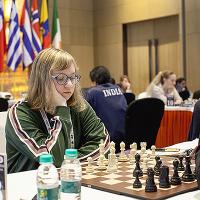

Hi Elizaveta! 👋
Your current picture
Blitz Peak: 2491 (2021-12-18) | Quick snapshot:
What you already do very well
- Tactical alertness. In the win against Zauur you converted a material edge with the neat finish …Ng3#. Your pieces were harmoniously placed and you spotted the mating pattern instantly.
- Opening variety. You switch comfortably between the French, Sicilian and 1.d4 systems, keeping opponents guessing and avoiding preparation traps.
- Conversion skills vs. lower-rated players. Most of your victories end well before move 30, demonstrating good technique and the discipline to keep things clean.
Targeted improvements
1. Handling the Trompowsky / London-style early Bxf6
Your most recent loss to Mistheoretical began with 1.d4 Nf6 2.Bg5 and the immediate
Bxf6 gxf6. The doubled pawns left your king exposed and encouraged White to open the centre.
Practical tips:
- Consider meeting 2.Bg5 with 2…d5 or 2…Ne4 to avoid structural damage altogether.
- If you do accept doubled pawns, follow up with …f5 only after completing development; otherwise the f-file opens before your rooks are connected.
- Keep the dark-squared bishop outside the pawn chain with …Bg7–f8–g7 ideas so that it can help to cover f5 and h5.
2. Early pawn thrusts on the a-file
Moves like …a5/…a4 appear frequently (e.g. vs. Mistheoretical and in several blitz losses). When they succeed they gain space, but they often cost two tempi and create new targets. Before pushing the a-pawn, run through a quick checklist:
- Are all minor pieces developed & king safe?
- Does it create a concrete threat (…a4 trapping a piece) this move?
- Can the pawn become weak if the queens are later exchanged?
3. Time-management pattern
In the time-forfeit vs. AliKa2810 you were still calculating around move 45 with < ~10 seconds on the clock.
- Aim to have at least 50 % of your starting time at move 15 and 25 % at move 30. If you’re below the benchmark, force yourself to simplify.
- Use forced sequences (checks/captures) to “think on the opponent’s time.” Decide your reply while their clock is ticking.
4. Expanding your black repertoire vs. 1.e4
Your Sicilians score well, but every so often you meet the Morra Gambit or odd sideline that can be awkward in 3-minute games. Having a second solid line (e.g. 1…e5 aiming for a Petroff or Berlin) will:
- Limit your opponent’s attacking chances when you simply need a draw.
- Give you a “thinking break” from theory-heavy Sicilians during long sessions.
5. Central tension in the French Exchange
In the win vs. Zauur you chose the flexible setup 5…h6 6.Bb5⁺ c6. Against stronger opposition you may extract more play with the classical plan:
1.e4 e6 2.Nf3 d5 3.exd5 exd5 4.d4 Nf6 5.Nc3 Nc6 6.Bb5 Bd6 7.O-O O-O 8.Bg5 h6 9.Bh4 Be6
This keeps the option of …c5 and avoids an early pawn hook on g4/h3.
Homework corner
- Analyse the critical moment after 15…Nb3! (Trompowsky loss) and build a small repertoire file with three candidate replies for White and your prepared antidotes.
- Play ten practice blitz games where you force yourself to castle before move 10 in every game. Review whether it improves clock usage.
- Solve 20 tactical puzzles focused on double-attack motifs—your wins show great calculation, but sharpening further will convert even more borderline positions.
Keep up the great work!
You are converting advantages confidently, and with small refinements in structure handling and clock control you’ll push beyond your current peak. Looking forward to your next milestones!
—Your Chess Coach