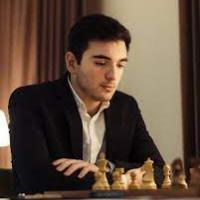
Robby Kevlishvili - The Grandmaster Maestro
Meet Robby Kevlishvili, the Grandmaster who could probably beat your computer before it finishes booting up. Known online as GroovyKettle, Robby is a whirlwind of chess brilliance wrapped in a cloak of nerves-of-steel and a dash of mischief.
A Journey Through the Ranks
Since bursting onto the competitive chess scene in 2019, Robby has electrified the blitz world, reaching an electrifying peak rating above 3090—a number so high it’s practically in space. Whether blitz, bullet, or rapid, Robby's playstyle is both tactical wizardry and relentless pressure. The guy’s winrate below his rating is a solid 60.67%, but he knows that true growth comes from battling giants and occasionally losing—those crushing defeats happened sometimes (we're looking at you, longest losing streak of 43 games).
Style and Stamina
Robby’s games often resemble a thrilling thriller movie: average moves per win hover at 84, meaning he is patient, precise, and cunning, like a chess ninja waiting for the perfect strike. Known for his psychological fortitude, Robby’s tilt factor is respectable (only 43), meaning he gets frustrated less than the average player throwing pieces angrily around. His best time to play? 7:00 AM – because while you’re hitting the snooze, Robby’s hitting checkmate.
Opening Repertoire – A Taste for Mystery
When it comes to openings, Robby guards his secrets well — “Top Secret” is definitely the name of his favorite opening, played thousands of times! But he does have a soft spot for the Sicilian Defense, especially the Open Najdorf and its spicy variations, no doubt keeping his opponents sweating bullets. Little known fact: he’s conquered variations like the Hyperaccelerated Dragon and London System, often leaving his adversaries wondering if they had even set up their pieces.
Chess Personality
With a comeback rate of 88.64%, if you think you’ve broken Robby’s spirit, think again! He fights back like a lion and has a winrate of over 40% even after losing a piece; talk about resilience. On a good day, he'll whip out spectacular moves that’d make Bobby Fischer smile, and on a not-so-good-day, well… he’s still a Grandmaster in the making.
Recent Battles
His latest triumphs include a graceful victory against NowayJosey by resignation in a Sicilian Najdorf English Attack (so fancy it sounds like a cocktail). Of course, even grandmasters have their off days — like when NowayJosey returned the favor with a checkmate just days later. But no worries, losing is just part of GroovyKettle’s epic chess saga.
Trivia
- Longest winning streak: A solid 18 games, which is basically a chess marathon.
- Average game length: Around 85 moves, because why end it quickly when you can build suspense?
- Favorite time to play: Early morning, proving that dawn really does bring out the Grandmaster in him.
- Online aliases: Go ahead, Google GroovyKettle – it’s the nickname that keeps chess forums buzzing.
- Psychological weapon: A calm demeanor that leads to many opponents forfeiting hope before the final move.
So next time you queue up for some online chess and spot GroovyKettle in the lobby, prepare your best moves — you’re about to face a grandmaster with a giggle and a gambit!
Quick summary for Robby Kevlishvili
Nice fight in your recent blitz block. You show a clear comfort with sharp pawn storms and tactical shots — the game where you opened the g‑file and crashed through the kingside is a good example. Your opening choices (especially the Sicilian Defense: Najdorf Variation and the Ruy Lopez: Morphy Defense, Anderssen Variation) give you practical chances, and your long history supports a high practical level (strength‑adjusted win rate ≈ 50.6%).
Concrete positives (what to keep doing)
- You seize the initiative well — pushing pawns to open lines and bringing major pieces quickly into the attack.
- Strong tactical vision: you spot deflections, exchanges on open files, and decisive combinations in blitz.
- Opening preparation is paying dividends — your Najdorf and sharp lines produce complex positions that favor your style.
- Good finishing instincts in winning positions — you convert attacking chances efficiently, as vs Wesley So.
Recurring problems to fix
- Back‑rank and king shelter: several losses ended with back‑rank or rook invasions (watch for patterns like ...Rc1# or ...Rxg2). Always check for luft or a defending piece when you castle.
- Counterplay from the opponent: aggressive wing advances sometimes leave central or queenside weaknesses that are punished by opening files against your king.
- Time trouble in the final minute: critical moments with under 30 seconds increase tactical errors. You can keep more buffer time for complicated positions.
- Occasional overextension: pawn storms without sufficient piece backup create holes and backward pawns opponents exploit.
Practical fixes — drills to start this week
- Tactics (15–25 min/day): focus on mating nets, deflection, overload and back‑rank motifs. Prioritize quality over quantity.
- Back‑rank routine: after castling, ask “Does my back‑rank need luft?” — if yes, play a pawn luft or prepare a rook lift. Drill 8–10 back‑rank positions per session.
- Mini‑game training (30 min twice/week): play 10+5 rapid games and practice converting small advantages while keeping time reserves.
- Opening checklist (10–15 min): for Najdorf and Ruy lines, write 3 typical plans and 1 trap to avoid for the key middlegame moves (move 12–20).
- Post‑game review: for each session, pick your worst mistake and analyze it for 3–5 minutes before using the engine.
Opening & middlegame adjustments
- Najdorf: keep a piece or pawn ready to cover the back‑rank when you commit kingside pawns — reduce c‑file counterplay by trading rooks only when it helps king safety.
- Ruy Lopez / Closed systems: avoid premature pawn grabs that open files toward your king without adequate piece coordination.
- Attacking checklist: before the decisive pawn push, confirm one defensive precaution (air, rook cover, or escape square for the king).
Time management checklist for blitz
- Keep ~12–15 seconds as a buffer for complex tactical sequences — use the increment to stay calm.
- Spend a few extra seconds when a pawn move will change the structure or open a file to your king.
- Use premoves only when there are no tactical intermezzos possible.
Short 4‑week practice plan
- Week 1: Tactics daily + 5 annotated quick games (10+5). Focus: back‑rank and mating nets.
- Week 2: 3 opening sessions (Najdorf + Ruy López), make a one‑page plan for typical middlegames.
- Week 3: Play 10 longer rapid games (15+10) — practice converting without time trouble.
- Week 4: Review your worst 10 games of the month; create “if‑this‑then‑that” rules for recurring errors (e.g., “if opponent sacrifices on g5, then …”).
Next steps & options
- Analyze the two decisive opponents: Wesley So and Dau Khuong Duy — study the turning points where your defensive options disappeared.
- Keep a simple error log: top 3 recurring mistakes per week. That will show patterns faster than raw stats.
- If you want, send 1–2 full games from this block and I’ll give line‑by‑line notes and 3 concrete training moves to fix the recurring issues.
Pre‑session checklist (two minutes)
- Warm up with 10 targeted tactics (back‑rank, pins, forks).
- Review one Najdorf / Ruy plan and decide the pawn‑storm threshold where you need a defensive precaution.
- Decide on a time split for the session to avoid flagging in tactical positions.
🆚 Opponent Insights
| Recent Opponents | ||
|---|---|---|
| Neferpitou27 | 4W / 9L / 4D | View |
| Rasmus Svane | 5W / 10L / 6D | View |
| Havard Haug | 2W / 1L / 0D | View |
| Tuan Minh Le | 23W / 40L / 5D | View |
| practice_makes_perfect123 | 0W / 2L / 2D | View |
| Ethan Sheehan | 10W / 4L / 3D | View |
| MaWrld0 | 3W / 3L / 4D | View |
| Isaak Parpiev | 2W / 1L / 0D | View |
| Anthony Wirig | 13W / 4L / 0D | View |
| I_Am_Whitebeard | 2W / 3L / 0D | View |
| Most Played Opponents | ||
|---|---|---|
| Daniel Naroditsky | 144W / 249L / 57D | View Games |
| Jorden Van Foreest | 126W / 148L / 41D | View Games |
| Alexander Rustemov | 66W / 41L / 17D | View Games |
| Brandon Jacobson | 41W / 51L / 16D | View Games |
| Michael Roiz | 26W / 37L / 31D | View Games |
Rating
| Year | Bullet | Blitz | Rapid | Daily |
|---|---|---|---|---|
| 2025 | 2949 | 3079 | ||
| 2024 | 3000 | 2986 | 2534 | |
| 2023 | 2842 | 2974 | 2540 | |
| 2022 | 2832 | 2929 | 2515 | |
| 2021 | 2795 | 2928 | 2153 | |
| 2020 | 2722 | 2908 | ||
| 2019 | 2660 | 2864 |
Stats by Year
| Year | White | Black | Moves |
|---|---|---|---|
| 2025 | 299W / 205L / 80D | 267W / 243L / 75D | 90.7 |
| 2024 | 297W / 203L / 59D | 232W / 259L / 79D | 91.6 |
| 2023 | 295W / 241L / 91D | 264W / 262L / 94D | 93.9 |
| 2022 | 240W / 187L / 52D | 208W / 215L / 55D | 89.2 |
| 2021 | 259W / 255L / 61D | 198W / 326L / 56D | 81.8 |
| 2020 | 396W / 443L / 153D | 366W / 484L / 133D | 87.5 |
| 2019 | 361W / 263L / 80D | 305W / 324L / 77D | 85.7 |
Openings: Most Played
| Blitz Opening | Games | Wins | Losses | Draws | Win Rate |
|---|---|---|---|---|---|
| Sicilian Defense: Najdorf Variation | 515 | 250 | 218 | 47 | 48.5% |
| Caro-Kann Defense | 269 | 119 | 106 | 44 | 44.2% |
| Sicilian Defense | 183 | 70 | 92 | 21 | 38.2% |
| Ruy Lopez: Morphy Defense, Anderssen Variation | 156 | 68 | 64 | 24 | 43.6% |
| Sicilian Defense: Alapin Variation | 155 | 64 | 66 | 25 | 41.3% |
| Modern | 143 | 67 | 55 | 21 | 46.9% |
| London System: Poisoned Pawn Variation | 136 | 54 | 55 | 27 | 39.7% |
| Sicilian Defense: Closed | 130 | 44 | 73 | 13 | 33.9% |
| Caro-Kann Defense: Two Knights Attack, Mindeno Variation | 108 | 50 | 42 | 16 | 46.3% |
| Hungarian Opening: Wiedenhagen-Beta Gambit | 108 | 41 | 49 | 18 | 38.0% |
| Bullet Opening | Games | Wins | Losses | Draws | Win Rate |
|---|---|---|---|---|---|
| Amar Gambit | 111 | 37 | 67 | 7 | 33.3% |
| Colle System: Rhamphorhynchus Variation | 97 | 38 | 56 | 3 | 39.2% |
| Caro-Kann Defense | 80 | 43 | 30 | 7 | 53.8% |
| Hungarian Opening: Wiedenhagen-Beta Gambit | 77 | 31 | 42 | 4 | 40.3% |
| Nimzo-Larsen Attack | 55 | 23 | 29 | 3 | 41.8% |
| London System: Poisoned Pawn Variation | 51 | 27 | 21 | 3 | 52.9% |
| Barnes Defense | 50 | 22 | 27 | 1 | 44.0% |
| French Defense | 45 | 22 | 21 | 2 | 48.9% |
| French Defense: Classical Variation, Svenonius Variation | 41 | 19 | 21 | 1 | 46.3% |
| Döry Defense | 41 | 21 | 14 | 6 | 51.2% |
| Rapid Opening | Games | Wins | Losses | Draws | Win Rate |
|---|---|---|---|---|---|
| Sicilian Defense: Najdorf Variation | 10 | 4 | 5 | 1 | 40.0% |
| Sicilian Defense: Moscow Variation | 7 | 3 | 3 | 1 | 42.9% |
| Sicilian Defense: Alapin Variation | 6 | 0 | 3 | 3 | 0.0% |
| London System: Poisoned Pawn Variation | 5 | 2 | 2 | 1 | 40.0% |
| Petrov's Defense | 5 | 2 | 1 | 2 | 40.0% |
| French Defense: Tarrasch Variation, Chistyakov Defense | 5 | 1 | 2 | 2 | 20.0% |
| QGD: 3.Nc3 Bb4 | 5 | 3 | 0 | 2 | 60.0% |
| Sicilian Defense: Four Knights Variation, Cobra Variation | 4 | 2 | 1 | 1 | 50.0% |
| Hungarian Opening: Wiedenhagen-Beta Gambit | 4 | 2 | 2 | 0 | 50.0% |
| Queen's Gambit Declined: Hastings Variation | 3 | 0 | 3 | 0 | 0.0% |
🔥 Streaks
| Streak | Longest | Current |
|---|---|---|
| Winning | 18 | 0 |
| Losing | 43 | 1 |