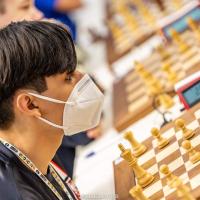
Overview
Joshua Adrian Avila Rodriguez (aka JoshuaGK27) is a FIDE Master and a prolific online competitor known for explosive blitz and thoughtful rapid play. A Rapid specialist by preference, Joshua combines tactical flair with deep endgame follow-through; his play history and peak achievements reflect a steady climb from club-level skirmishes to elite online performance. Keywords: Joshua Adrian Avila Rodriguez, FIDE Master, JoshuaGK27, Rapid chess, Blitz specialist, Sicilian Najdorf.
- Title: FIDE Master (FM)
- Preferred time control: Rapid (online specialist)
- Peak highlights: Blitz peak 2697 (2025-06-09) and Rapid peak 2200 (2024-05-20)
- Quick chart (Rapid history):
Career & style
Joshua's trajectory is the story of a player who loves to mix sharp opening preparation with marathon endgame technique. From 2020 onward he recorded long winning streaks and a high average game length — a sign that his games often go the distance. He is comfortable in complex middlegames and is notorious for turning around lost-looking positions.
- Playing style: tactical-minded with high endgame frequency (many games finish beyond move 80).
- Notable streaks: longest winning streak of 25 games and remarkable comeback metrics.
- Psych profile: intense competitiveness with a tilt factor that shows he's human — he recovers quickly and often swindles favorable results.
Openings & repertoire (what he plays and beats)
Joshua favours sharp, tested systems but also enjoys surprise lines that frustrate bookish opponents. In blitz he often reaches for the Sicilian Najdorf and Caro‑Kann; in bullet and blitz he explores offbeat gambits and chaos lines to maximize practical chances.
- Sicilian Najdorf — heavy usage and many games (Blitz: 444 games, win rate ≈ 47.8%)
- Caro‑Kann — reliable choice (Blitz: 332 games, win rate ≈ 53.3%)
- Sicilian Closed & Alapin — flexible approaches vs. 1.e4
- French Defense: Advance Variation — a frequent battleground (wins often in long fights)
- Fun crossovers: sometimes lures opponents into a Botez Gambit-style trap in casual rooms; loves labeling sloppy foes as a Loose Piece when the tactic lands.
Memorable games & a quick puzzle
Below is a tiny demonstrative mini-game — a cheeky reminder to always watch out for early queen sorties. Try it as a quick tactical warmup.
- Miniature (learn-from-it):
- Note: Joshua mixes such traps into his blitz repertoire to punish overconfident opponents and to keep time-pressure opponents on edge.
Statistics snapshot & performance trends
Joshua's logged games reveal a player who performs well across controls but truly shines when the clock is generous enough to allow calculation. He keeps a healthy win rate vs. similar-skill opponents, and his endgame frequency shows he’s willing to grind for every half-point.
- Strength-adjusted win rates: Rapid stands out (stronger than his blitz/bullet baseline).
- Preferred hours: strong midday performer (12:00 noted as best time); also solid results in late evening blitz.
- Opponent habits: several frequent opponents with long histories — some matchups are lopsided in his favor while others remain close rivalries.
Personality, nicknames & trivia
On and off the board Joshua is approachable, occasionally self-deprecating, and not shy about joking when a game ends in wild skittles. Opponents have given him playful handles in chat rooms — a mix of affectionate ribbing and respect for his gutsy choices.
- Common nicknames in chat: "Pawn Grubber", "Juicer", and the occasional "Octo-Knight" after a crazy knight tourney game.
- Streaming / community vibe: enjoys post-mortems, explaining tactical motifs and why a Loose Piece is never safe.
- Offbeat interests: likes experimenting with quirky openings in casual rooms — the kind that produce "coffeehouse chess" fireworks.
Coaching & how to follow
Joshua is open to teaching projects and focused training in openings, practical endgames, and rapid tournament preparation. He emphasizes practical chances over pure engine lines and loves helping players convert long, technical positions into wins.
- Offers: opening workshops, rapid game review, and endgame clinics.
- Best contact approach: in-game messages or hosted simuls and post-mortems (when available).
- Handy terms in his teaching notes: Swindle, Practical chances, Book move.
Included placeholders
This profile includes interactive placeholders so the host app can render charts and game viewers dynamically.
- Rating chart for Rapid history:
- Peak rating stats: 2697 (2025-06-09) and 2200 (2024-05-20)
- Sample game (PGN viewer):
- In-text glossary links: Botez Gambit, Loose Piece, Pawn Grubber
Quick overview
Great work — your recent rapid games show a consistent ability to turn small advantages into wins. You grab material, activate rooks and the queen quickly, and punish opponent mistakes. Below I’ll highlight what you’re doing well, the repeating problems to fix, and a short training plan so you keep improving.
Replay your most recent win
Review this game to see how you converted a material advantage and used an active queen/rook battery to finish. Replaying it and pausing at key moments will help you internalize the plans.
- Quick replay:
- Opening: Zukertort Variation (Queen's Pawn Opening). You transitioned from opening to active play quickly — good job.
- Opponent for this game: antoniogarcia77
What you do well
- Material-minded and opportunistic — you take tactical chances to win pawns and then convert them. Several wins show good conversion of small material edges into a full point.
- Active major pieces — you use rooks and queen on open/semi-open files to create mating threats and force weaknesses (example: invading on the 7th and picking off pawns).
- Opening variety and results — you’re comfortable in many openings (Sicilians, Alekhine, Reti/Zukertort lines) and tend to get favorable positions out of the opening.
- Strong practical play — you make effective choices in rapid time controls and your win record shows good decision-making under the clock.
Recurring issues to fix
- King safety / early king moves: you sometimes move the king early or keep it in the center (for example an early king shift). It worked here, but it’s risky — prefer to castle or create a safe pawn structure before wandering the king.
- Pawn grabbing can be double‑edged: you win pawns (b7, c7, a7 in recent games) — great — but ensure the resulting pawn structure and king exposure are safe. Before grabbing, ask: “Will development or opponent counterplay compensate?”
- Coordination before tactics: sometimes you win material and then must cleanly coordinate a plan to convert. Try to simplify into clear winning endgames or force decisive checks rather than juggling pieces aimlessly.
- Occasional loose-piece chances from opponents: you punish them well — but don’t rely on opponents hanging pieces. Work on building winning positions even when the opponent doesn’t blunder.
Concrete drills & short training plan (4 weeks)
Small, focused practice gives big returns in rapid. Do these drills 4–6 times per week.
- Tactics (20–30 min/day): focus on pins, forks and back-rank motifs. Set a daily puzzle target and review every missed tactic — understand why you missed it.
- Endgames (2× week, 20 min): rook and pawn vs rook, basic queen vs pawn endings and king + pawn races. Convert typical material advantages you often reach.
- Opening refinement (2× week, 30 min): pick 2 main systems (your Zukertort/Queen’s pawn repertoire and one Sicilian line). Learn 3 typical middlegame plans from model games instead of memorizing long move-lists.
- Play + review (3 rapid games/week): after each game, do a 10–15 minute post-mortem focusing on the turning point — not the whole game. Note one improvement to apply next time.
- One longer game per week (15|10 or 30|0): practice deeper calculation and endgame technique. Use this to train patience converting advantages.
Practical tips for your next games
- Before grabbing a pawn, scan for opponent counterplay: open files toward your king, piece activity and checks.
- When ahead, simplify on your terms: trade pieces when it reduces opponent counterplay but keep rooks/queen if they increase your winning chances.
- Use quiet waiting moves to improve worst-placed pieces (prophylaxis). Often the active move is not the immediate tactic but a slow improvement.
- Time management: keep at least 3–4 minutes on the clock before entering complex tactical sequences in 10-minute games — avoid “time trouble” guesses.
- One thought per move in quiet positions: pick a plan (improve a piece, create pawn break) and execute it. Avoid aimless moves that lose momentum.
Next-review checklist (after your next 10 games)
- Count how many wins came from opponent blunders vs how many came from sustained strategic play. Aim to increase the latter.
- Track how many times you left your king exposed after pawn grabbing — reduce that number each review cycle.
- Note one recurring tactical motif you miss and focus puzzles on that motif for two weeks.
Small encouragement & final notes
You've built a solid practical score and a reputation for converting advantages. Keep polishing king safety and conversion technique. With focused tactics + endgame work, you’ll make those wins more routine instead of opportunistic.
- Want a targeted plan? Tell me which opening you play most and I’ll give a 2-week study plan for it.
- Revisit this win: antoniogarcia77 and the replay above to pick 2 moments where a different move would have been stronger — that will speed learning.
🆚 Opponent Insights
| Recent Opponents | ||
|---|---|---|
| Markovian Vladimirov | 1W / 1L / 0D | View |
| onewany | 1W / 1L / 0D | View |
| gugutkica | 1W / 0L / 1D | View |
| stefan_stojiljkovic | 0W / 2L / 0D | View |
| Martin Oksendal | 0W / 2L / 0D | View |
| egotomoe | 1W / 0L / 0D | View |
| esfuerzo2300 | 0W / 2L / 0D | View |
| Dragomirescu Robin | 1W / 1L / 0D | View |
| Anderson Esmeraldas | 0W / 0L / 1D | View |
| piqueso | 2W / 0L / 0D | View |
| Most Played Opponents | ||
|---|---|---|
| ErnestoGuevaraLynch | 19W / 16L / 4D | View Games |
| Alfeu Junior Varela Bueno | 14W / 21L / 3D | View Games |
| petitpingouin06 | 12W / 17L / 1D | View Games |
| Alan Stein | 1W / 23L / 4D | View Games |
| Steve Berger | 15W / 11L / 1D | View Games |
Rating
| Year | Bullet | Blitz | Rapid | Daily |
|---|---|---|---|---|
| 2025 | 2700 | 2200 | ||
| 2024 | 2653 | 2625 | 2200 | |
| 2023 | 2501 | 2544 | ||
| 2022 | 2450 | |||
| 2021 | 2256 | 2326 | 2064 | |
| 2020 | 2240 | 2163 | 1776 |
Stats by Year
| Year | White | Black | Moves |
|---|---|---|---|
| 2025 | 739W / 778L / 167D | 712W / 830L / 129D | 89.3 |
| 2024 | 452W / 432L / 78D | 427W / 477L / 62D | 89.5 |
| 2023 | 116W / 115L / 23D | 118W / 120L / 20D | 86.8 |
| 2022 | 33W / 25L / 1D | 28W / 26L / 2D | 91.5 |
| 2021 | 118W / 67L / 5D | 105W / 70L / 7D | 75.9 |
| 2020 | 237W / 116L / 13D | 204W / 154L / 14D | 72.7 |
Openings: Most Played
| Bullet Opening | Games | Wins | Losses | Draws | Win Rate |
|---|---|---|---|---|---|
| Sicilian Defense: Closed | 53 | 31 | 18 | 4 | 58.5% |
| Amar Gambit | 33 | 26 | 6 | 1 | 78.8% |
| Czech Defense | 29 | 16 | 11 | 2 | 55.2% |
| French Defense: Advance Variation | 29 | 17 | 12 | 0 | 58.6% |
| Modern | 22 | 16 | 5 | 1 | 72.7% |
| Bird Opening: Dutch Variation, Batavo Gambit | 21 | 12 | 9 | 0 | 57.1% |
| Barnes Defense | 19 | 11 | 7 | 1 | 57.9% |
| Scandinavian Defense | 19 | 11 | 8 | 0 | 57.9% |
| Sicilian Defense: Accelerated Dragon | 19 | 13 | 6 | 0 | 68.4% |
| Alekhine Defense | 18 | 9 | 6 | 3 | 50.0% |
| Blitz Opening | Games | Wins | Losses | Draws | Win Rate |
|---|---|---|---|---|---|
| Sicilian Defense: Najdorf Variation | 444 | 212 | 206 | 26 | 47.8% |
| Caro-Kann Defense | 337 | 178 | 134 | 25 | 52.8% |
| Sicilian Defense: Closed | 267 | 132 | 115 | 20 | 49.4% |
| French Defense: Advance Variation | 257 | 135 | 97 | 25 | 52.5% |
| Sicilian Defense | 210 | 93 | 103 | 14 | 44.3% |
| Sicilian Defense: Alapin Variation | 166 | 76 | 71 | 19 | 45.8% |
| London System: Poisoned Pawn Variation | 159 | 64 | 86 | 9 | 40.2% |
| English Opening: Agincourt Defense | 150 | 63 | 75 | 12 | 42.0% |
| Bird Opening: Dutch Variation, Batavo Gambit | 135 | 56 | 65 | 14 | 41.5% |
| Czech Defense | 123 | 56 | 52 | 15 | 45.5% |
| Rapid Opening | Games | Wins | Losses | Draws | Win Rate |
|---|---|---|---|---|---|
| Sicilian Defense: Accelerated Dragon | 4 | 3 | 1 | 0 | 75.0% |
| Sicilian Defense: Closed | 3 | 2 | 1 | 0 | 66.7% |
| French Defense: Advance Variation | 3 | 2 | 1 | 0 | 66.7% |
| Sicilian Defense | 3 | 3 | 0 | 0 | 100.0% |
| Sicilian Defense: Nyezhmetdinov-Rossolimo Attack, Fianchetto Variation | 2 | 1 | 0 | 1 | 50.0% |
| East Indian Defense | 2 | 2 | 0 | 0 | 100.0% |
| Alekhine Defense | 2 | 2 | 0 | 0 | 100.0% |
| King's Indian Defense: Exchange Variation | 1 | 1 | 0 | 0 | 100.0% |
| Ruy Lopez: Schliemann Defense | 1 | 1 | 0 | 0 | 100.0% |
| Ruy Lopez: Morphy Defense, Anderssen Variation | 1 | 1 | 0 | 0 | 100.0% |
🔥 Streaks
| Streak | Longest | Current |
|---|---|---|
| Winning | 25 | 3 |
| Losing | 10 | 0 |